


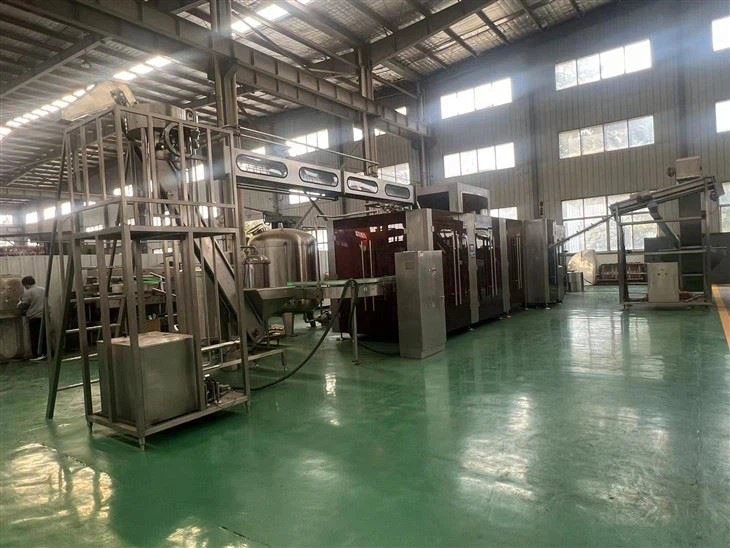


Production Process
A blow-fill-cap machine typically first feeds the preforms into a heating unit, where they are heated using 7-10 stages of far-infrared radiation. A robotic arm then feeds the heated preforms into a blow mold, where they are blown into the desired bottle shape using high-pressure gas. The bottles are then transferred to the filling station, where they are filled using gravity or isobaric methods, depending on the material and process requirements. Finally, at the capping station, a magnetic constant-torque capping head secures the cap to the bottle finish, completing the packaging process.

Details

Bottle blowing partThermoplastic plastic sheets are blown into containers through a mold. PET materials are usually used. After forming, the empty bottle preform is obtained.

Filling part
Select the corresponding filling method (hot filling, aseptic filling, etc.) according to the product type (such as drinking water, carbonated beverages, etc.), and inject the liquid into the bottle through the pipe.

Capping partAutomatically tighten the bottle cap to ensure sealing
Product advantages

High Production Efficiency: Integrating the three processes of bottle blowing, filling, and capping into a single machine reduces intermediate transfers and empty bottle handling, eliminating waiting time and transmission losses between processes. The machine operates at high speeds and covers a wide range of production capacities, with some ultra-high-speed models capable of up to 108,000 bottles per hour.
Lower energy consumption: Some equipment is equipped with a unique high-pressure air recovery system that can save more than 30% of compressed air. Others use energy-saving heating systems and optimized cooling systems to reduce overall energy consumption.
Good sanitary conditions: Since the intermediate links are reduced, the empty bottles do not need to be exposed to the air for a long time, which reduces the risk of empty bottle contamination and improves the packaging sanitary conditions. It is especially suitable for beverage production with high hygiene requirements.
Core Features
Integrated Process
In traditional production, blow molding (molding PET raw materials into bottle shapes), filling (injecting liquid), and capping (sealing the bottle mouth) are separate processes connected by conveyors. However, the blow-fill-cap machine integrates all three into a single device. After the preforms are heated and blown into bottles, they are directly transported to the filling station and finally capped. This process is seamless, minimizing secondary contamination.
High Speed and Efficiency
Mainstream equipment can produce 10,000-80,000 bottles per hour, accommodating various bottle sizes (e.g., 330ml-2L) and offering flexible changeovers (fast switching between bottle types and volumes via parameter settings).

Matching the production needs of the Blowing, Filling and Capping Machine
Production capacity: Select equipment based on current and future production plans for the next 3-5 years (e.g., if the average daily production capacity is 100,000 bottles, choose equipment that can produce 20,000-30,000 bottles per hour, leaving some redundancy);
Bottle specifications: whether it is necessary to be compatible with multiple specifications (such as producing 500ml and 1.5L bottles at the same time), and the equipment's changeover efficiency (such as whether the changeover time is within 30 minutes.
Hot Tags: Filling And Capping Machine, China Filling And Capping Machine manufacturers, suppliers, factory


