

Hey there! As a supplier of sleeve labeling machines, I've had my fair share of experiences with different container materials and how our machines work with them. In this blog, I'm gonna break down the compatibility of our sleeve labeling machines with various container materials.
Let's start with plastic containers. Plastic is one of the most common materials out there for packaging, and it comes in different types like PET (Polyethylene Terephthalate), HDPE (High - Density Polyethylene), and PVC (Polyvinyl Chloride). Our Fully Automatic Sleeve Labeling Machine is a real champ when it comes to labeling plastic containers.
PET containers are widely used for beverages, food products, and cosmetics. They have a smooth surface, which makes it relatively easy for the sleeve label to adhere properly. The machine can precisely cut and place the sleeve label around the PET container, ensuring a tight and wrinkle - free fit. The heat shrink process that our machine uses also works great on PET, as it shrinks the label uniformly without causing any damage to the container.
HDPE containers are often used for household chemicals, detergents, and some food items. They are a bit more rigid than PET. Our sleeve labeling machine can handle HDPE containers just fine. The grippers and conveyors in the machine are designed to hold and move the HDPE containers steadily during the labeling process. And when it comes to shrinking the label, the machine can adjust the heat settings to achieve the best results on HDPE.
PVC containers, on the other hand, are less common nowadays due to environmental concerns, but they are still used in some niche applications. The surface of PVC can be a bit sticky, which might seem like a challenge. However, our machine has been fine - tuned to deal with this. The cutting mechanism ensures a clean cut of the sleeve label, and the application process is carefully controlled to prevent the label from sticking prematurely or unevenly on the PVC container.
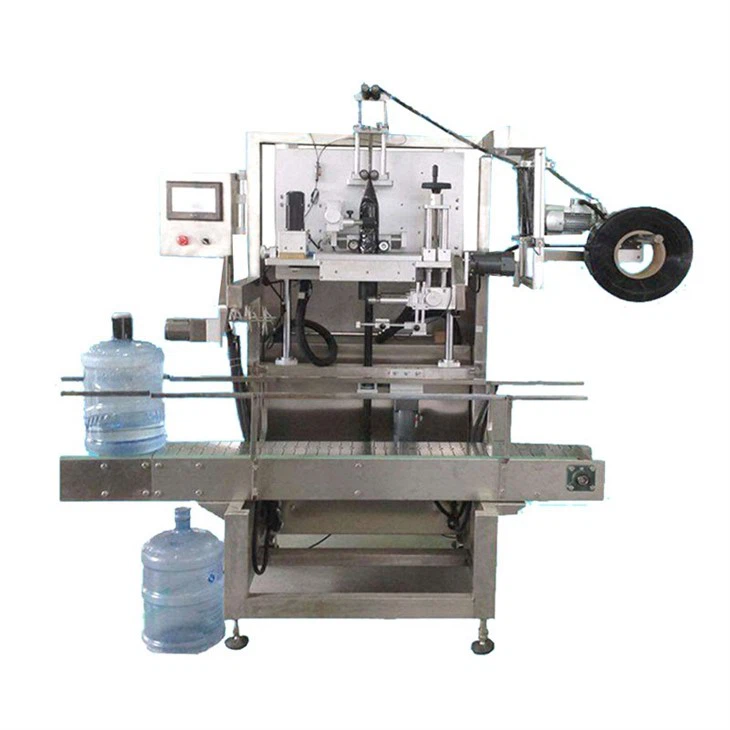
Next up, we have glass containers. Glass is a classic material for packaging high - end products like wines, spirits, and premium cosmetics. Glass containers have a very smooth and hard surface. Our Large Bucket Water Sleeve Labeling Machine can be used for larger glass containers, but we also have models suitable for smaller ones.
The main thing with glass is that it doesn't expand or contract like plastic during the heat shrink process. So, our machine has to be very precise in placing the sleeve label. The sensors in the machine detect the position of the glass container accurately, and the label is then placed at the right spot. The heat shrink process on glass is also different. Since glass is a good conductor of heat, we need to be careful not to overheat it. Our machine has temperature sensors that monitor and adjust the heat to ensure that the label shrinks properly without cracking the glass.
Metal containers are another type of container material that we often encounter. Metal containers are commonly used for canned foods, aerosols, and some industrial products. Aluminum and tin - plated steel are the most common metals used in these containers.
Our Double Head Sleeve Labeling Machine can label metal containers efficiently. Metal containers have a shiny and smooth surface, which can be a bit slippery. But our machine has special suction cups and grippers that hold the metal container firmly during the labeling process. The heat shrink process on metal is also unique. The machine needs to heat the label enough to shrink it, but not so much that it affects the metal's properties. And since metal is a good heat conductor, the heat distribution has to be even to avoid any uneven shrinking of the label.
Now, let's talk about cardboard containers. Cardboard is used for packaging a wide range of products, from cereal boxes to shipping containers. Cardboard containers are usually more porous than plastic, glass, or metal. Our sleeve labeling machines can handle cardboard containers, but there are some considerations.

The label has to be applied in a way that it adheres well to the porous cardboard surface. We've designed our machines to apply a bit more pressure during the label placement to ensure good adhesion. The heat shrink process also needs to be adjusted. Since cardboard is a poor conductor of heat, we need to use a bit more heat and a longer shrinking time to get the label to shrink properly on the cardboard container.
Paper containers are also similar to cardboard in some ways. They are often used for single - use food items like cups and cartons. Our sleeve labeling machine can work with paper containers too. The main challenge with paper is that it can be easily damaged by heat. So, our machine uses a lower heat setting and a more gentle shrinking process. The label is also designed to be more flexible so that it can conform to the shape of the paper container without causing any tearing or warping.
In addition to these common container materials, we also get requests for labeling containers made of composite materials. Composite containers are made by combining different materials, like plastic and paper or metal and plastic. These containers can have unique surface characteristics. But our R & D team has been working hard to make our sleeve labeling machines compatible with composite containers. We adjust the cutting, placement, and shrinking processes based on the specific composition of the composite container.
To sum it up, our sleeve labeling machines are highly compatible with a wide variety of container materials. Whether it's plastic, glass, metal, cardboard, paper, or composite materials, our machines have been designed and tested to provide the best labeling results. We understand that different industries have different requirements, and we're always ready to customize our machines to meet those needs.
If you're in the market for a sleeve labeling machine and have specific container materials in mind, don't hesitate to reach out to us. We can help you choose the right machine for your products and provide all the technical support you need. Let's start a conversation about how our sleeve labeling machines can take your packaging to the next level.
References
- Packaging Machinery Handbook: A comprehensive guide on packaging machinery and their applications
- Journal of Packaging Science and Technology: Articles on the latest trends and research in packaging materials and labeling technologies
So, if you're interested in our sleeve labeling machines, just contact us for a detailed discussion and let's work together to get the perfect labeling solution for your business.