

The laser wavelength is a critical parameter that significantly influences the marking quality of a laser coding machine. As a leading supplier of laser coding machines, we understand the intricate relationship between laser wavelength and marking outcomes. In this blog post, we will delve into the science behind laser wavelengths and how they impact the marking quality of our laser coding machines.
Understanding Laser Wavelength
Laser wavelength refers to the distance between two consecutive peaks or troughs of a laser beam's electromagnetic wave. It is typically measured in nanometers (nm). Different laser sources emit light at specific wavelengths, and these wavelengths determine the interaction between the laser beam and the material being marked.
There are several common laser wavelengths used in laser coding machines, including ultraviolet (UV) lasers (around 355 nm), green lasers (around 532 nm), and infrared (IR) lasers (around 1064 nm). Each wavelength has its unique properties and is suitable for different applications based on the material's absorption characteristics.
Impact of Laser Wavelength on Marking Quality
Material Absorption
The absorption of laser energy by a material is highly dependent on the laser wavelength. Materials have specific absorption spectra, which means they absorb certain wavelengths more effectively than others. When the laser wavelength matches the absorption peak of the material, the material can efficiently absorb the laser energy, leading to better marking results.
For example, UV lasers are well - suited for marking polymers and plastics because many polymers have strong absorption in the UV region. The high - energy photons of UV lasers can break the chemical bonds in the polymer molecules, resulting in a clear and permanent mark. On the other hand, IR lasers are often used for marking metals because metals have good absorption of infrared light. The heat generated by the absorbed IR laser energy can cause melting or vaporization of the metal surface, creating a visible mark.
Marking Resolution
The laser wavelength also affects the marking resolution. Shorter wavelengths generally allow for higher marking resolution. This is because the diffraction limit, which restricts the minimum spot size that a laser beam can be focused to, is proportional to the laser wavelength. According to the Rayleigh criterion, the minimum spot size (d) of a focused laser beam is given by (d = 1.22\frac{\lambda}{NA}), where (\lambda) is the laser wavelength and (NA) is the numerical aperture of the focusing lens.
As the wavelength (\lambda) decreases, the minimum spot size (d) also decreases. UV lasers, with their short wavelengths, can achieve very small spot sizes, enabling high - resolution marking. This is particularly important for applications that require fine details, such as marking serial numbers, barcodes, or micro - patterns on small components.
Heat Affected Zone (HAZ)
The heat affected zone is an area around the marked region where the material's properties are altered due to the heat generated by the laser. The size of the HAZ is influenced by the laser wavelength. Longer wavelengths, such as IR lasers, tend to generate more heat in the material because the energy is absorbed over a larger volume. This can lead to a larger HAZ, which may cause unwanted effects such as thermal stress, cracking, or changes in the material's mechanical properties.
In contrast, UV lasers have a relatively small HAZ. Since the UV photons have high energy and are absorbed mainly at the surface of the material, the heat is concentrated in a very thin layer. This makes UV lasers suitable for marking heat - sensitive materials, such as electronic components or medical devices, where minimizing the HAZ is crucial.
Application - Specific Considerations
Packaging Industry
In the packaging industry, laser coding machines are used to mark product information, expiration dates, and barcodes on various packaging materials. For plastic packaging materials, UV lasers are often preferred due to their high absorption by plastics and the ability to produce high - resolution marks. For example, when marking on PET bottles, a UV laser can create clear and durable marks without damaging the bottle's surface.
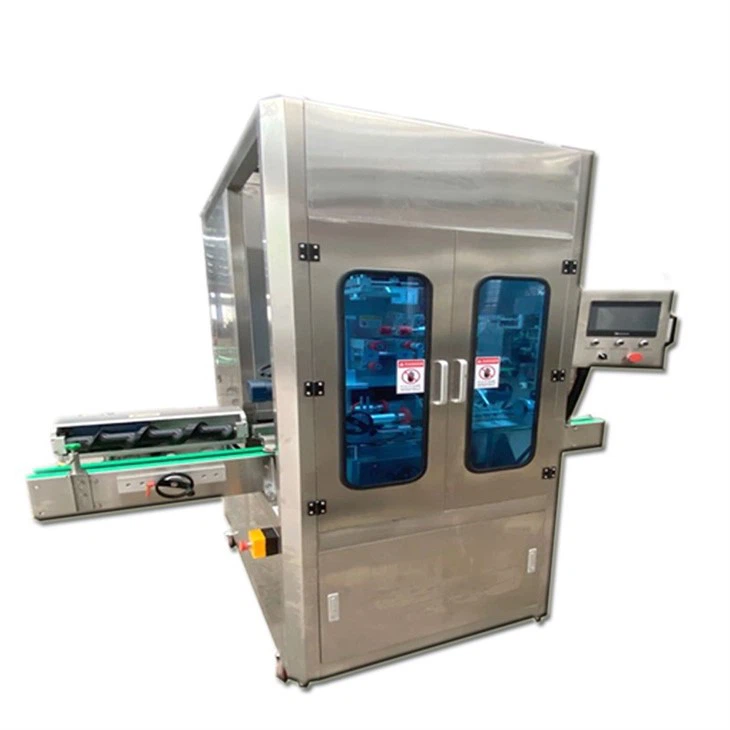
If you are also looking for labeling solutions in the packaging industry, we offer a range of labeling machines. Check out our Fully Automatic Sleeve Labeling Machine, Double Head Sleeve Labeling Machine, and Large Bucket Water Sleeve Labeling Machine for efficient and precise labeling.
Automotive Industry
The automotive industry requires high - quality and durable markings on various components, such as engine parts, chassis, and electronic modules. IR lasers are commonly used for marking metals in this industry. They can create deep and permanent marks on metal surfaces, which are resistant to wear, corrosion, and high - temperature environments.

Electronics Industry
In the electronics industry, marking on printed circuit boards (PCBs), semiconductor chips, and other electronic components demands high precision and minimal heat damage. UV lasers are the ideal choice for these applications because of their high resolution and small HAZ. They can mark fine traces, component numbers, and logos on delicate electronic parts without affecting their functionality.
Selecting the Right Laser Wavelength for Your Application
When choosing a laser coding machine, it is essential to consider the material to be marked and the desired marking quality. Here are some guidelines:
- Plastics and Polymers: UV lasers are generally the best choice for marking plastics and polymers due to their strong absorption in the UV region, high resolution, and small HAZ.
- Metals: IR lasers are suitable for marking metals because metals have good absorption of infrared light, and IR lasers can create deep and permanent marks.
- Heat - Sensitive Materials: UV lasers are preferred for marking heat - sensitive materials, such as electronic components and medical devices, to minimize the heat affected zone.
As a supplier of laser coding machines, we have a team of experts who can help you select the most appropriate laser wavelength for your specific application. We offer a wide range of laser coding machines with different wavelengths to meet the diverse needs of our customers.
Conclusion
The laser wavelength plays a crucial role in determining the marking quality of a laser coding machine. By understanding the relationship between laser wavelength, material absorption, marking resolution, and heat affected zone, you can make an informed decision when choosing a laser coding machine for your application.
Whether you are in the packaging, automotive, electronics, or any other industry, we are committed to providing you with high - quality laser coding machines that can meet your marking requirements. If you are interested in our products or have any questions about laser coding, please feel free to contact us for a detailed consultation and procurement negotiation.
References
- "Laser Materials Processing" by G. Chryssolouris
- "Handbook of Laser Technology and Applications" edited by C. Brederlow, D. Bäuerle, and K. Sokolowski - Tinten