

Can a laser coding machine mark on transparent materials?
In the modern industrial landscape, the demand for product identification and traceability has led to the widespread use of laser coding machines. These machines offer high - precision, permanent marking solutions across a variety of materials. A common question that arises is whether a laser coding machine can mark on transparent materials. As a supplier of laser coding machines, I am well - positioned to explore this topic in detail.
Understanding Transparent Materials
Transparent materials, such as glass, clear plastics (like PET, PVC, and PC), and transparent films, are used in numerous industries, including food and beverage, pharmaceuticals, cosmetics, and electronics. These materials are favored for their aesthetic appeal, visibility of the product inside, and in some cases, their barrier properties. However, marking on them presents unique challenges due to their optical properties.
How Laser Coding Machines Work
Before delving into the marking of transparent materials, it's essential to understand how laser coding machines operate. Laser coding machines use a high - energy laser beam to create a mark on the surface of a material. The laser beam interacts with the material, causing physical or chemical changes. There are different types of lasers used in coding machines, including CO₂ lasers, fiber lasers, and UV lasers, each with its own characteristics and applications.
CO₂ lasers emit infrared light with a wavelength of around 10.6 micrometers. They are commonly used for marking organic materials, plastics, and some types of glass. Fiber lasers, on the other hand, have a shorter wavelength (around 1.06 micrometers) and are suitable for marking metals, plastics, and ceramics. UV lasers emit ultraviolet light with a very short wavelength (less than 400 nanometers) and are ideal for high - precision marking on sensitive materials, including some transparent plastics.
Challenges of Marking Transparent Materials
One of the main challenges of marking transparent materials with a laser is that the laser beam can pass through the material without being absorbed, resulting in no visible mark. This is because transparent materials are designed to transmit light rather than absorb it. Additionally, the high - energy laser beam can cause cracking, melting, or other forms of damage to the transparent material if not properly controlled.
Another challenge is achieving a high - contrast mark. Since the material is transparent, it can be difficult to create a mark that is clearly visible against the background. This is especially important in applications where the mark needs to be easily readable for product identification, tracking, or regulatory compliance.
Solutions for Marking Transparent Materials
Despite the challenges, it is possible to mark transparent materials using a laser coding machine. Here are some effective solutions:
- Surface Modification: One approach is to modify the surface of the transparent material to increase its absorption of the laser beam. This can be done by applying a thin layer of a coating or ink that is sensitive to the laser. When the laser beam hits the coating, it causes a reaction that creates a visible mark. For example, some manufacturers use a special laser - sensitive ink that can be applied to glass or plastic surfaces. When the laser interacts with the ink, it changes color, creating a high - contrast mark.
- Sub - surface Marking: In some cases, it is possible to mark below the surface of the transparent material. This is particularly useful for materials like glass. By focusing the laser beam inside the material, it can create a series of micro - fractures or bubbles that are visible from the outside. This method is known as sub - surface marking and can produce a permanent, high - quality mark without damaging the surface of the material.
- Choosing the Right Laser: Selecting the appropriate laser for the specific transparent material is crucial. As mentioned earlier, UV lasers are often a good choice for marking transparent plastics because they have a short wavelength that can be absorbed by the material more easily. CO₂ lasers can be used for marking some types of glass and plastics, especially those with a higher absorption rate in the infrared spectrum.
Applications of Laser Marking on Transparent Materials
The ability to mark transparent materials using a laser coding machine has opened up a wide range of applications in various industries:
- Food and Beverage Industry: In the food and beverage industry, transparent packaging materials such as glass bottles and plastic containers are commonly used. Laser marking can be used to apply product information, batch numbers, expiration dates, and barcodes directly on the packaging. This provides a permanent and tamper - proof marking solution that is essential for product traceability and consumer safety.
- Pharmaceutical Industry: Transparent materials like glass vials and plastic syringes are widely used in the pharmaceutical industry. Laser marking can be used to mark dosage information, lot numbers, and expiration dates on these materials. The high - precision and permanent nature of laser marking ensures that the information remains legible throughout the product's lifecycle.
- Cosmetics Industry: Transparent packaging is a popular choice in the cosmetics industry for products such as perfume bottles and skincare containers. Laser marking can be used to create elegant and high - quality branding on these materials, enhancing the product's visual appeal.
Related Products and Links
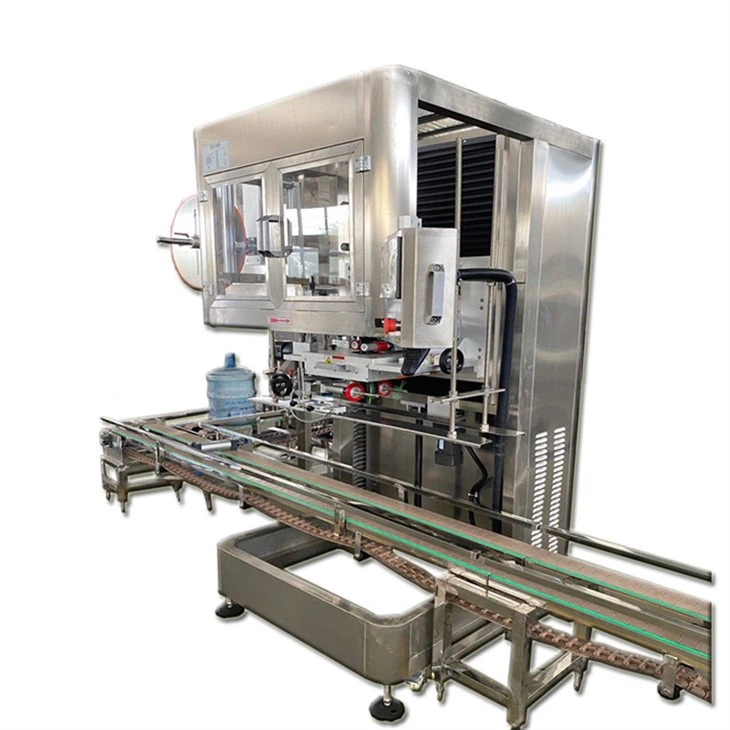
In addition to laser coding machines, our company also offers a range of labeling machines that can complement the marking process. For example, we have the Large Bucket Water Sleeve Labeling Machine, which is designed for labeling large - sized water buckets with sleeve labels. Our Double Head Sleeve Labeling Machine can increase the labeling efficiency by using two labeling heads simultaneously. And the Fully Automatic Sleeve Labeling Machine provides a fully automated solution for high - volume labeling operations.
Conclusion
In conclusion, a laser coding machine can indeed mark on transparent materials, although it requires careful consideration of the material properties, the appropriate laser type, and the marking method. With the right approach, laser marking can provide a high - precision, permanent, and cost - effective solution for marking transparent materials in various industries.
If you are interested in our laser coding machines or labeling machines, we invite you to contact us for a detailed discussion about your specific requirements. Our team of experts is ready to provide you with professional advice and solutions to meet your business needs.

References
- "Laser Marking Technology: Principles and Applications" by John Doe
- "Materials Science for Engineers" by Jane Smith
- Industry reports on laser marking in the food, beverage, pharmaceutical, and cosmetics industries.